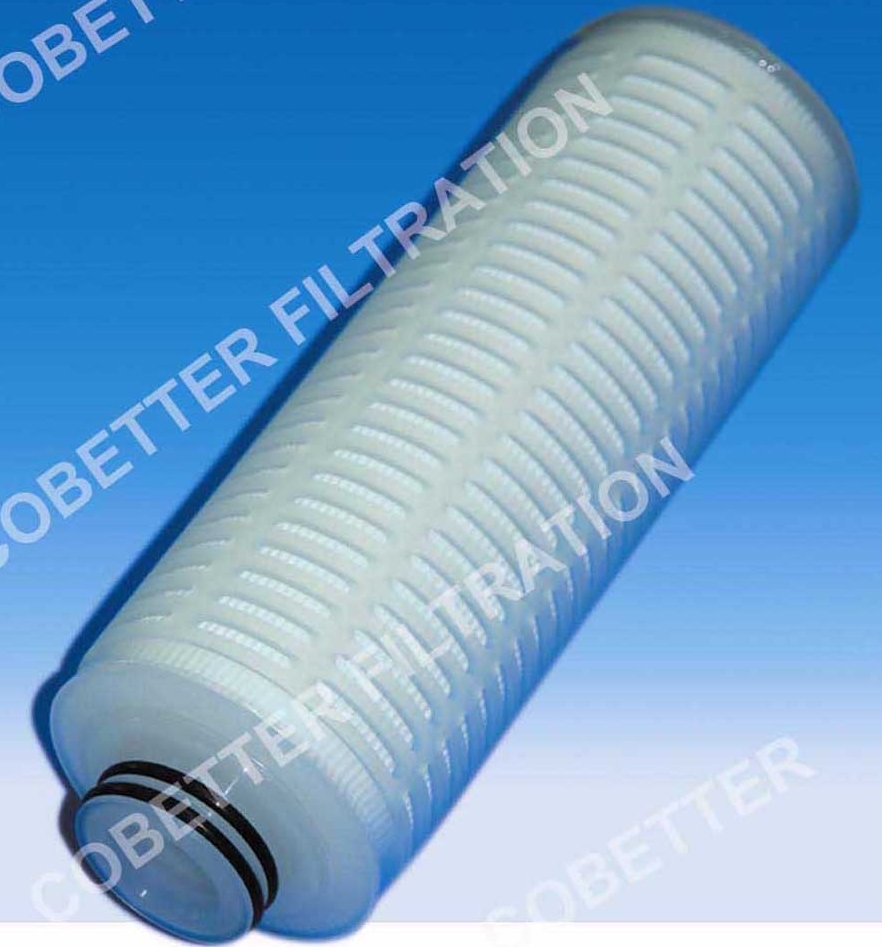
Depth filter cartridge
Lifecycle stage
Batch production
Communities




Facets
Facets
Product gallery
1 product images
Attributes
Connections and wetted materials
Fluid connection type
The connection method used at the product's fluid ports, such as threaded, flanged or welded connections. Select each method present, retaining inlet and outlet assignments when they differ. It helps assess piping compatibility; size, thread form, pressure rating and connection standard are separate details.
End connection standard
The standard designation defining the product's fluid end connections. Record the exact code and edition from the drawing or specification, identifying the port when connections differ. It helps verify mating compatibility; conformity of a connection is not certification of the entire product.
Body material
The material of the product's main body or housing. Use the manufacturer's construction specification and retain detailed grades or coatings when given. It affects mechanical durability and environmental resistance, but does not establish compatibility of all internal parts with a process medium.
Seal material
The material of the identified seal or gasket. Use the manufacturer's designation and preserve grade or formulation details. It helps assess compatibility and maintenance; a generic elastomer name alone does not establish suitability at every concentration and temperature.
Wetted materials
The materials of components that directly contact the process fluid in normal operation. Select all documented contact materials, including relevant linings, seals and membranes. They help assess chemical compatibility and contamination risks; external housing material alone is not a complete wetted-material specification.
Filtering parameters
Filtration stage
*
The stage in a stated multi-stage filtration process for which the element is intended. Use the manufacturer's process description. It helps place an element in a system; a stage name does not establish a retention rating or a sterilisation claim.
Preliminary cleaning; Intermediate cleaning
Micron rating
*
The particle-size rating of a filter element under a stated retention criterion. Record the size, unit and nominal, absolute or other test basis. It helps assess filtration capability; size alone is not a percentage efficiency or a complete test result.
3 μm
Compatible medium
*
The substances or process media with which the product is declared compatible. Select only documented media and retain restrictions on concentration, temperature, pressure and exposure. It helps avoid damage or contamination; it does not describe what a filter removes or what an instrument measures.
Drinking water
Filtration operation
Volumetric flow rate
The volume of fluid passing through the product per unit time under stated conditions. Record the specified flow with its medium, temperature and pressure or pressure-drop conditions. It helps assess throughput; gas flows stated at different reference conditions are not directly interchangeable.
Pressure drop
The decrease in fluid pressure between the product's inlet and outlet at a stated flow and condition. Use the manufacturer's value with the medium, flow and clean-or-used state identified. It helps estimate pumping or fan requirements; it is not the maximum pressure difference the product can withstand.
Maximum differential pressure
The greatest allowed difference between pressures on opposite sides of the product during specified operation. Use the manufacturer's limit, including direction and temperature conditions. It helps prevent mechanical damage; it differs from housing pressure rating and normal operating pressure drop.
Service life
The expected useful life of a filter element under documented service conditions. Preserve whether the declaration uses time, treated volume, cycles or an end-condition rule. It helps plan replacement; different service-life bases are not equivalent units.
Operating temperature range
The lowest and highest temperatures at which the product can operate within its stated limits. Use the manufacturer's operating specification and retain the temperature location, load and exposure conditions. The range helps assess application suitability; storage temperature and the temperature being measured are different specifications.
Filtration performance
Filter medium material
The material that performs filtration, adsorption or separation within the element. Select the material stated by the manufacturer, not the fluid being treated or the support housing. It affects separation behaviour and chemical compatibility; pore size and filtration efficiency are specified separately.
Effective micron rating
The effective particle-size rating declared for a filter under a stated retention criterion. Preserve the value, unit and retention basis. It helps describe separation performance; particle size and percentage retention are different quantities, so percentage-formatted historical values require interpretation before reuse.
Filtration efficiency
The proportion of a stated target retained or removed by a filter under an identified test. Record the percentage with particle size or substance, method and conditions. It helps compare separation; efficiency without a target and test basis is incomplete.
Effective filtration area
The area of filter material available for the intended filtration process. Use the manufacturer's effective area, not the external area of the housing. It helps compare loading and flow potential, but a larger area alone does not establish efficiency or service life.
Operating conditions
Regeneration supported
Whether the manufacturer permits a procedure that restores the filter element for further use. Use Yes only for a documented cleaning or regeneration procedure. This affects maintenance and replacement planning; it does not make arbitrary rinsing, sterilisation or chemical cleaning safe or effective.
Possible to clean up
Sterlization
Possibility of sterilization
Sterillisable
Method of sterilization
Allowable methods of sterilization
Аutoclaving; Steam
Number of cycles by steam sterilization (30 min at 121 °C)
Number of cycles by steam sterilization during 30 minutes at 121 °C
Recommended operation temperature
Range of temperatures recommended for the use of the product
-30 - 90
Storage temperature range
The lowest and highest temperatures allowed while the product is stored and not operating. Use the manufacturer's storage limits, retaining restrictions on duration, packaging or state of charge. The range helps prevent deterioration before use and does not give permission to operate at those temperatures.
Pressure and flow
Nominal pressure
The nominal pressure-class designation under the stated piping or component standard. Record the exact label and standard. It helps select compatible specifications; a class number is not automatically the allowed operating pressure at every temperature.
Test pressure
The pressure applied during the specified proof or other pressure test. Retain method, duration, medium and acceptance conditions. It helps interpret test evidence; it is not the permitted continuous operating pressure.
Nominal size
The nominal size designation of a fluid component under its stated sizing system. Preserve the complete label from the drawing. It helps match nominal sizes; it is not necessarily the measured internal or external diameter.
Technical parameters
Gasket
Gasket matirial
Silicone
End caps type
Е 1 - flat blanking cap
Е 2 - spear (or bomb-fin)
E 3 - recessed closed cap
Е1; Е2
Core
Filtration materials
Polypropylene (PP)
Support/Drainage
Filtration materials
Polypropylene (PP)
Cage
Cage matirial
Polypropylene (PP)
O-Ring
O-Ring matirial
Silicone
Thermal bonding tecgnique
End Fittings
Filter Cartridge End Fittings:
Double Open End (DOE) cartridges are, as the name implies, open at both ends and rely on the sealing arrangement within the housing to close one end of the filter and so direct flow through the other end;
Single Open End (SOE) cartridges are those which have one end of the cartridge already 'blocked' with a blanking end cap, and the other end open but with an end cap attached with built in 'O' rings, giving a much more efficient and reliable seal than the DOE configuration.
Single Open End (SOE)
Adapter type
А 1 - 44, 5mm and 2 x 222 'O' rings
А 2 - 44, 5mm and 2 x 222 'O' rings with double bayonet
А 3 - 44, 5mm and 2 x 222 'O' rings with 3 lug bayonet
А 4 - 56 mm and 2 x 226 'O' rings
А 5 - 56 mm and 2 x 226 'O' rings with double bayonet
А 6 - 56 mm and 2 x 226 'O' rings with 3 lug bayonet
А1; А2; А3
Testing results
Weight and dimensions
Weight
The mass of the product in its stated configuration, without transport packaging. Use the manufacturer's net mass and retain which accessories or working fluids are included. This helps plan handling, supports and installation; it is not shipping weight.
Length
*
The overall length of the product along the direction shown in its drawing. Use the external dimension for the stated configuration, including projections when specified. It helps check fit and installation space; working stroke, reach and diameter are separate dimensions.
30 in
Overall diameter
Outside diameter or overall diameter - is the outer diameter measured in the center
71
Inside diameter
Inside diameter - diametr between inner borders
30
Shipping weight
Weight with packaging